 A lack of manifested evangelistic outreach can easily depress us. We often see a severe lack of interest in the word of God in our community. We see souls who need the Gospel, and we wonder how we can effectively present it to them. Some will simply refuse to be saved, according to their words and actions. They lack a spiritual appetite. We must remember that Jesus and His apostles could not reach everyone. Still, God has not given us an impossible task.
If someone is saved, they will be saved by the Gospel. Romans 1:16 speaks of the Gospel as the “power of God”; Luke 8:11 shows us that the Word is seed; 1 Corinthians 1:22-25 proves that some will not obey. In the face of what is perceived as an ongoing evangelistic problem, many seek alternate methods to attract people. Ostensibly, their aim is to attract them to come to church services, then teach them the Gospel while they are there. However, in practice, it becomes all about the programs and gimmicks. They might build large and elaborate church buildings, concoct expensive recreation programs, or invite famous entertainers or sports figures. These are not legitimate means of garnering attention to the Word of God; the simple reason being that they are not scriptural in approach. These methods, instead of promoting or supporting the spread of the Gospel message, actually get in the way. In 1 Corinthians 2:1-5 we learn that Paul avoided worldly skill and oratory. He could have used Man’s wisdom to impress people with his level of knowledge, but he didn’t. In the same way, we must never “sugar coat” our approach to the Gospel. It robs the Gospel of its power, and practically, it never works. Truth cannot compete with error with the general population. Men will never adequately search for truth without the urge to seek it. The Roman Colosseum of the 1st Century was the “super bowl” of the day, where slaves were pitted against each other to the death, or fed to hungry animals. This was what the people wanted, and in some respects it is no different today. Many will be satisfied with the elaborate building and recreational programs. Even as we see today, many are leaving the denominations for “community churches”, places built up as supposedly serving the community, rather than serving the Lord. While leaving divisive groups is often a good thing, the question must be raised as to whether they are truly “leaving”. Many community churches, even while claiming a status of being “nondenominational”, nonetheless ascribe to (primarily) Southern Baptist creeds. The same things are being done and said, perhaps with some of the concepts and ideas shifted slightly, but ultimately there is no difference. In many similar ways, Christians can get in the way of the Gospel even without these unscriptural activities. When we use too many examples about ourselves when teaching or exhorting, our appeal can become, “look at me!” rather than “look at Jesus!” When we seek the approval or appreciation of others instead of the glory of God, we can pride ourselves as being right rather than knowing and teaching that God is right. When we ridicule the beliefs or positions of others, we disparage our own cause and give no real reason for outsiders to become interested in the Bible. When someone hungers after the truth about life and seeks knowledge in the Word of God, honestly and intently, nothing will stand in their way, but let the Christian resolve to work hard to NEVER be a stumbling block. John writes, “whoever says he abides in him ought to walk in the same way in which he walked.” (1 John 2:6). When it comes to understanding and practicing the truth, we are our own worst enemies. Thus, in seeking to tell others about Jesus, we must be proper adherents of what we claim to believe. We must “adorn the doctrine” (Titus 2:10). Put simply, others must see Christ in us. The term “adorn” comes from the greek kosmeō, which means “to put in proper order; to garnish”. Thus, adorning is not adding or taking from the content; only enhancing it to others so it becomes more attractive. Some might think that “adorning the doctrine” means doctoring it up with a bunch of things that it doesn’t need. Others might assume that “adorning the doctrine” means taking out anything that might offend the hearer. We know that Jesus never did either of these things, and neither did any of the Apostles. “[adorning] the doctrine”, especially in the context of Titus 2, means that we are doing our best to live the life that we espouse to be the best way to live, as taught by God’s Word - His “doctrine”. Anyone can “adorn the doctrine” The context of Titus 2:10 is toward “bondservants” (2:9), but there is much in the idea that we can all appreciate. The most important place to “adorn the doctrine” might be the home. 1 Peter 3:1-4 tells us that the wife is to be adorned not especially in the outward way, but the inward way, the “Hidden person of the heart”. The same could be said of the husband. Many have been saved through their spouse “adorning the doctrine”. 1 Corinthians 7:16 shows us a situation where the believing wife, in her action and character, can help save the unbelieving husband. Similarly, neighbors, friends, sons or daughters can be led to Christ through our “[adorning] the doctrine”. To “adorn the doctrine” is to live a Godly life. We need to consider our habits (1 Peter 2:11-16). If our attitude is Godly, we will point others to God. Even in persecution, we can adorn the doctrine (1 Peter 3:14-17). Further, to “adorn the doctrine” requires true joy in our hearts. No one will be truly converted only because of how nice or happy we are. In fact, many can see through a fake smile. And even if the smile is genuine, just being happy will not by itself make a difference in the lives of many. If we read about the early Christians in Acts 2:47,5:41,16:34; Mat. 5:16, we learn how to be joyful despite a wicked world. To “adorn the doctrine”, we require consistency. Ofte, the relationships we enter into in life suffer because of a lack of consistency in belief and practice. Ultimately, we should erect healthy boundaries in our relationships in order to work toward God’s pleasure. 1 Thessalonians 5:9-10 tells us that “whether we are awake or asleep” we must seek God’s pleasure. If we fail to “adorn the doctrine”, we become the stumbling block by which others will falter. Our community must see Christians as people who are pure in lifestyle and speech, who are good parents, generous with others, loving, and kind. Read Matthew 18:1-5 and consider how we can have a consistent and genuine love for a broken world. While this world is broken, WE ARE NOT, and we should never live in such a way. God has lifted us up to something better! May we all reach for that Godly goal. Are you adorning the doctrine of Christ? -Steven McCrary  If you were to ask a Christian for a “creed” of the church of Christ, he could only offer you a copy of the New Testament. The only written creed the church that Christ built has ever had is the New Testament. It was given by the inspiration of God unto all good works. 2 Tim. 3:16-17. It meets the needs of the entire world. Mark 16:15-16. This is the only message we are authorized to use in the conversion of sinners. 1 Cor. 9:16; Matt. 28:18-20.
Jesus taught that the word of God is enduring and that by it we shall be judged. Luk. 21:33; John 12:48. The authority of Jesus as expressed in the New Testament is the only safe guide for the church. It is sinful for the church to submit to any other authority. The gospel is God’s power to save. Rom. 1:16. James says it is able to save. James 1:21. Paul writes that it did save the Corinthians. 1 Cor. 15:1-4. The curse of God rests upon the man who preaches another gospel or dares to add to or subtract from it. Gal. 1:8-9; Rev. 22:18-19. In spite of the plain Bible teaching above, we find good, religious people subscribing to human creeds. Even those who subscribe to man-made creeds will not claim for them any saving power. They are but the products of human opinion and stand as barriers to the unity of religious people. Man-made creeds are based upon two wicked assumptions: (1) The New Testament is not sufficient to meet the needs and govern the people of God. (2) This supposed insufficiency can be remedied by weak, fallible, erring men. Without such assumptions there is no excuse for the making of any human creeds. Human creeds are objectionable for a number of reasons:
As simple Christians we take the authority of Jesus as expressed in the New Testament as our only rule of faith and practice. It is the one creed that needs no revision. In work and worship all can be united scripturally ONLY ON the NEW TESTAMENT.— Rufus R. Clifford in MESSENGER OF TRUTH, published in the Columbus Dispatch by Aubrey Belue, Sr. on March 19, 1970.
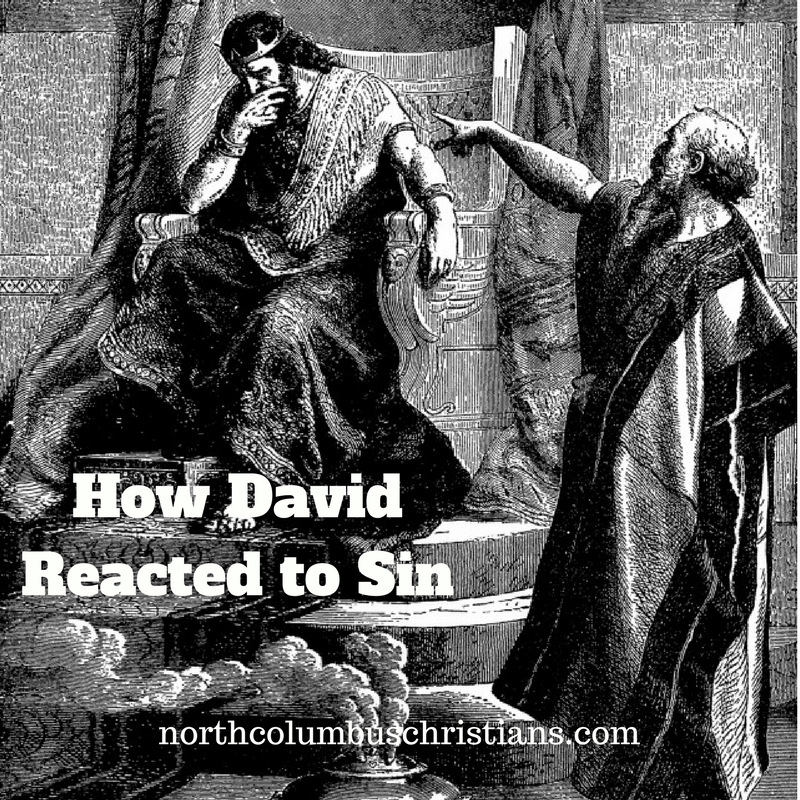
Have you ever read this passage of Paul recounting the history of his people and considered what is recorded concerning David? Among the first things we typically think of when we think of David is his sin with Bathsheba, but there is no mention of this sin in the New Testament. There is a reason that David was “a man after God’s own heart”. We learn much from the examples of Godly men in Scripture, and the way that David treated sin is a great lesson to learn.
David did his best to avoid sin. In the early days after David was anointed, King Saul did his best to make David’s life miserable. He tried to kill David at least 11 times (1 Sam. 18:11,17,21; 19:1,10,11,15,20-22; 23:15; 26:2) Most in this world would work hard to repay Saul for his cruelty, but David did not. David had two opportunities to end these problems and easily take the throne. However, in 1 Sam. 24:1-7, 10 David does not kill the man that God had placed as King. This might seem odd, especially since God had already told Saul that his reign was going to end because he was not faithful (1 Sam. 13:13-14). We have no way of knowing whether David knew of this exchange, but even if he didn’t, nowhere do we see David given a command to kill Saul. In 1 Sam. 26:7-11, David is given a second chance to kill Saul, and he doesn’t even have to do it himself! He forbids Abishai to kill Saul because Saul is still the king that God had anointed to lead Israel. This is what authority is all about. God didn’t ask for it, so David will not do it. If we want to avoid sin, we must be prepared to do no less and no more than what God asks for. Even when Saul is dead, David is not happy about it (2 Sam. 1:5-16). David is free from this pressure of Saul seeking his death, and even has the crown at his disposal – but this fails to make him joyful. This is because David was not seeking his own will – he intends to do the will of God, no matter what. Our Savior was the same way – “I seek not my own will but the will of him who sent me.” (John 5:30). As we have referred previously, there was one time that David did NOT do his best to avoid sin. The sin with Bathsheba and the following plot to kill Uriah (2 Sam. 11) We can note two things: David was at home when he likely should have been in the field of battle with his men (11:1), and David pushed for an opportunity to meet with Bathsheba, when it should have ended there (11:2-5). There are many great lessons to learn from these events, but for the purpose of this article, we must understand that despite all of David’s great achievements, he was still a man with the desires of a man. The prophet Nathan showed David the sin that he had committed (2 Sam. 12:1-15). It is hard to believe that David did not realize the grievous error he had made. In essence, Nathan told David, “You could have had anyone you wanted, but you took what belonged to someone else.” It is notable that David, with his sin fully revealed, seems to immediately respond with “I have sinned against the LORD.” (12:13). Over the rest of his life, it would seem that David continued to seek the will of God in dealing with this great sin. In Psalm 38, David is “plagued” with his great sin. In Psalm 32, David is joyful over being forgiven of this sin. What a Godly example for us! In all this, David was indeed "a man after God's own heart". We see this clearly in Psalm 51. David was a man who sought God’s mercy (1-6), a man who sought God’s cleansing (7-13), and a man who sought God’s pleasure (13-19). David was a great man, but far from perfect. However, it wasn’t that he was perfect – only that he was penitent. May the same be said of us! -Steven McCrary |
 RSS Feed
TimesSunday 9 a.m., 10 a.m., 11 a.m.
Wednesday 6:30 p.m. |
|